Thursday, May 27, 2010

Meridian Sooloos


It's all the things you value about music, instantly accessed via the world's most advanced user interface and a rich, visual, touchpanel experience.

It stores your music library in pristine lossless digital quality, with effortless backup protection for your treasured collection.

It plays your music anywhere you need it, with immediate access and instant enjoyment of your favourite songs, in one room or many, for a single listener or the whole family.

It seamlessly integrates full-quality home listening and personal players for when you're away.

It's a complete system, built of the finest components, offering a unique experience dedicated to the continual enjoyment of music.

The touch-screen interface makes your collection easily manageable with intuitive simplicity and enormous power. It's designed with a deep understanding of music and delivers an experience that reflects the unique value your music library holds for you.

The components of your Meridian Sooloos system give you centralized access to your collection of CDs and digital audio files, at full lossless quality, wherever you need it.

The components discover one another automatically and require no configuration when attached to the same network, for easy setup and daily reliability.

From living room to kitchen, bedroom to patio, kids' rooms to media room, Meridian Sooloos lets you browse and play your central library throughout your home with simple setup, appliance-like reliability, and dependable, effortless backup.

Quite simply, it's the world's most advanced digital media system.

System price: $13,000.

The storage drives are available in 1TB and 2TB models called the Store:One and Store:Two (D'oh!). Other system attributes: super low-jitter design, DC coupled signal path, ground-free transformer-coupled digital output, 192kHz/24-bit converters, and servo-balanced analog outputs.

www.meridian-audio.com/sooloos

Marten Design FormFloor Speakers


The FormSeries represents a new concept of loudspeaker design from Leif Marten Olofsson, chief designer and founder of Swedish manufacturer Marten. After creating award-winning loudspeakers that have reached out to audiophiles around the world, he wanted a new challenge—to create a beautiful and simple geometrical form that would fit into the interior of any contemporary home, yet provide the high-end sound quality and cabinetry for which Marten loudspeakers have become so well known.

It goes without saying that the cabinets of the FormSeries loudspeakers are extremely well built, but why the unusual shape? The triangular configuration of the FormFloor and FormCentre models is acoustically optimized to allow the speakers to totally disappear within the soundstage. If you close your eyes, the only thing that’s left is the music.

The cabinet of a high-end loudspeaker is not only one of the most important contributions to its stellar performance, but one of the most obvious. There are other, less obvious things that are also very important. The FormFloor employs custom, pure ceramic midrange/bass drivers that give dynamic and powerful bass (from 36 Hz) and a transparent and musical midrange.


The ribbon tweeters, instead of the ceramic or diamond tweeters of the bigger brothers, provide sweet, seductive sound all the way up to 40 kHz. To my ears, the ribbon was a great choice and did, in some ways, create a more appealing every-day response than the stiff domes. Having heard the Marten Birds, Miles IIIs, Coltrane Supremes and Dukes, I think the new Form speakers are my favorite Martens far. Of course, I may just be in love with the looks, hard to say.

The bass response via the bottom-firing port was tremendous. The Form speakers, as the perfect design-conscious speakers they are, don't need a sub for satisfying high-performance, every-day listening.

All FormSeries loudspeakers are provided with magnetically-attached grilles that allow the user to decide if he wants to keep them on or off—the speakers look and sound great with or without them. The down-firing bass reflex ports make it easy to position the FormSeries loudspeakers in the listening environment.


FormFloor

Frequency range: 36-40,000 Hz +/-3dB
Power rating: 150W
Sensitivity: 87 dB/w/m
Impedance: 8 ohm (5.9 ohms minimum)
Type: Ported system, port resonance 34 Hz
Drive units: 7” ceramic mid/woofer, 2.2” ribbon tweeter
Crossover: Second order, 3000 Hz
Cabinet: 19mm MDF
Dimensions: 21 x 110 x 33 cm (W x H x D)
Weight: 37.7 lbs.
Finishes: High-gloss black, white, maple, cherry, walnut
Price: $6,500 / pair

Source: SONICFlare on Feb 04 '08, Hifi Unlimited on Nov 6, '09

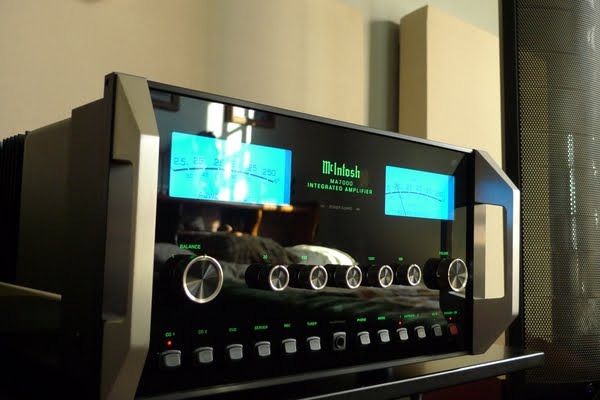
McIntosh MA-7000 Integrated Amp Review


It doesn’t require a potions degree from Hogwarts to apperceive your familiarity with the McIntosh name. For 60 years, the venerable company has held to the tradition of serving generations of audiophiles, musicians, and wealthy professionals with first rate audio electronics. It’s one of the few brands in the business that is so synonymous with hi-fi that even a non-enthusiast muggle stands a chance of recognizing the trademark vintage green moniker and big blue power meters. Today Sonicflare takes a look at one of the latest additions to enter the McIntosh catalogue, the MA7000 integrate amplifier.

Under the hood

Weighing in at nearly 100lbs, measuring roughly 17.5”W x 9.5”H x 22”D, dishing out a solid 250wpc into 8, 4, and 2 ohms, and flashing a shelf tag of $8000.00 USD, the MA7000 asserts itself as the most substantial, most powerful, and most expensive integrate to ever adorn the McIntosh stripes. Sporting a massive retro look that un-bashfully exudes confidence, power and refinement, it’s the proverbial antithesis of slim lifestyle sized hardware. When around the MA7000, it’s easy to lose ones sense of propriety. After wrestling the unit out of its shipping carton and setting it on the equipment, you cannot help but feel that it is one of the most bad-ass integrated amplifiers ever released by a mainstream manufacturer south of the $15,000 mark. So what exactly is under the hood of this thing?

In a nutshell, the MA7000 is a modified MC252 amplifier with an analog passive-pre-amp attached to it. The pre-amp section on board the MA7000 is virtually identical to the MA6900 integrated. What sets the MA7000 apart from its little brother is the amplification section, which takes the MC252 and gives it a better circuit layout for improved sound quality along with ThermalTrak technology for lower distortion and more efficient operation. According to McIntosh, the amplifier housed inside of the MA7000 outperforms a stand-alone MC252.

From the polished stainless steel chassis to the glass front panel and the big blue illuminating power meters, everything on the MA7000 communicates bona fide Mac-ism. Exclusive to the MA7000 are a set of machined aluminum rack handles that flank each side of the front panel. I found these handles to be as practical as they are aesthetically pleasing, as the extra grip they provide makes it easier to manage dealing with the 97.5 pound piece while moving it around and positioning it on an equipment rack. Another first for the MA7000 is a full set of balanced inputs and outputs which enables connectivity to a wider array of products. It is important to note however that the MA7000 is not a natively balanced design and instead operates off the standard single-ended circuit.

Many integrate amplifiers in this price class are often purist in nature and thus lack many features that are found even on inexpensive entry level components. McIntosh feels this shouldn’t be so, and incorporates a number of useful additions to the MA7000 uncommon with competitive products in this range such as a built-in high quality Moving Magnet (MM) Phono-stage for the vinyl lover, a first class headphone section for the ‘can’ enthusiast, and a very effective 5-band equalizer for those who want to toggle between linearity and color, the latter being particularly useful when listening to recordings that never received the audiophile treatment. Just a little more bass here or a little less treble there and suddenly you’ll find yourself listening to music you long discarded due to inept sound quality.

For McIntosh, bullet proof construction is equally as important as sound quality and features. Built to provide decades of reliable and consistent performance, the MA7000 is chalk full of technologies that help prevent life shortening wear and tear on both the unit itself and your loudspeakers. From the use of long lasting fiber optic lighting to a number of innovative circuits such as McIntosh’s own Sentry Monitor, which protects against voltage spikes, and Power Guard, a circuit that monitors the input and output signals and adjusts voltage on the fly to prevent harmful clipping, it’s difficult to imagine an electrical circumstance that could pierce through the MA7000’s built-in protection.

The MA7000 also includes Autoformers, which are low distortion transformers that output consistent power into loudspeaker impedances of 2, 4, or 8 ohm’s. With 250 watts per channel, there aren’t too many loudspeakers on planet earth that the MA7000 cannot power well. To top it all off, McIntosh employs its own ThermalTrak technology to ensure that the amp stays nice and cool. While most amplifiers rely on a separate transistor to control the bias along the main voltage rails, ThermalTrak devices are physically attached to each output power transistor inside the amp. This allows for instantaneous bias control which results in lower distortion and more efficient operation. It also means that the amp will run cooler and ultimately last longer.

Throw in data ports for home automation, a full functional remote control, an exceptionally well written user manual and a 3 year warranty and the only thing missing from this piece is an attachment that serves you breakfast in bed.


From the U.S.A with love

Performance Summary: The Yin

There’s a longstanding joke among some audiophiles that McIntosh solid state components sound more lush and romantic than their tube counterparts. Because I am such a greenhorn with Mac gear, I’m unable to form a worthwhile take on the matter. That said, my stint with the MA6300 integrate last summer confirmed that at least one current-production transistor piece of theirs has a presentation that can be categorized as lush. Since most ubiquitous manufacturers keep to the sacrosanct tradition of maintaining a ‘house sound’ throughout a product line, I felt it was safe to assume that the MA7000 would inherit the MA6300’s character, albeit en’ improved form. As it turns out, my assumption was far off the mark.

The moment the MA7000 began playing music was the very moment I realized that the only thing this piece had in common with the MA6300 is a similar look and the same brand logo. There was no doubting it, not even for a second. While the MA6300 has an enjoyable sound that is reminiscent of classic 60’s and 70’s era hi-fi, the MA7000 takes on a modern and polished presentation that is all about resolution, transparency, and linearity. There is no detectable grit to the highs. No blossom and bloom in the midrange and bass. Instead, the sound is balanced, powerful, controlled, and clean. Wise tales be damned, the MA7000 is a piece that proudly champions solid state chops without ever attempting to sound like something that it’s not.

With all EQ parameters set to flat, the MA7000’s lack of an obvious aural fingerprint makes it an easy candidate to submit under the “tell it like it is” camp. It’s the type of piece that will show you everything going on in your system, for better and for worse. For some listeners, this open, dynamic, transparent, and detail oriented sound will be music to the ears. For others, it may be a bit too much of a good thing. If you happen to fall into the latter camp, don’t worry. McIntosh has already got you covered with the built in EQ, which not only allows you to flavor the sound according to your taste, but also allows you to adjust the sound per individual recording! Also, bear in mind that linear sounding amplifiers enable you to color the sound in different ways, be it your cables, your source, or what have you. Personally, I prefer the sound with the EQ set to flat. Leaving things in this configuration, I feel that the presentation of the MA7000 rests comfortably between the classic ‘up close and personal’ and the ‘mid-hall’ denotations. This means that the sound is forward enough to capture the raw energy of a live performance without ever rubbing your nose in it. Ultimately though, every component has its own character. If I had to pick a word to describe the MA7000’s sound, it would be ‘dark’. Well, ok, how about “slightly dark”.

Straight out of the box, one of the most standout virtues of the MA7000, aside from its power and fine integration of the main frequency bands, is the amount of detail it effortlessly extracts from a recording. Though its rendering of detail is unquestionably revealing in nature, the MA7000 sounds incredibly smooth on the top end and never dips into the grit and grain territory that plagues many other high end “tell it like it is” components. Of course, along with this clarity comes all the wonderful sense of air and separation around the instruments and vocalists that one should expect from a component at this price point, thus enabling you to hear further into a recording and to gather a fresh perspective on familiar music.

Much like the top end, the midrange on the MA7000 is quick, full of detail, air, and sports a very open and linear sound. Those of you who believe that the midrange is the most important aspect of sound reproduction and feel that it should never suffer from artificial flavoring will absolutely love how the MA7000 plays music. It simply recreates whatever is fed through it. If the recording is open and rich sounding, that’s what you’ll get. If it’s lean and thin, that’s what you’ll get. This is certainly not an integrate that suffers from the “sameness” effect, which is a byproduct of tonal color that ultimately causes all of your music to sound the same. Instead, the MA7000 allows you to explore your music collection and enjoy a varied experience from disc to disc.

Glancing at the MA7000’s monstrous façade, it’s easy to assume that the bass will be as bombastic as the look itself. After all, there is usually a parallel between the way a component looks and the way that it performs. Although the appearance of the MA7000 suggests that it may overwhelm your system with gargantuan bass, what it actually delivers flows right in line with the rest of its presentation, preferring instead to give a quick, detailed, finely balanced, and tactile response. With the MA7000, the measure of good bass is all about how it integrates into the music, which as many would argue, is exactly how it should be.

Make no mistake about it though, the MA7000 can rumble when called upon to do so. In fact, the MA7000 may be one of the few integrates that can genuinely surpass numerous high power separate components in terms of delivering raw visceral dynamic power. If someone were to tell me that the MA7000’s ability to provide the current necessary to accurately reproduce the sensation of a live performance were its most salient attribute, I wouldn’t disagree. Indeed, even at low volumes, the mighty integrate has the ability to project sound in a way that mimics the interplay between live instruments inside of a room.

Performance Summary: The Yang

Picking apart components of this pedigree can be challenging because most of the pieces that occupy this echelon are fairly well engineered and well rounded products. Usually it takes a direct compare and contrast sessions against two similar components to fully assess what one item brings to the table that the other does not. In this review, I’m going to use the Karan Acoustic KA I-180 integrated as an example.

At $10,500, the Karan is notably more expensive than the MA7000. It’s also marketed towards a completely different type of buyer – the purist. The MA7000 by contrast is built to appease a wider audience ranging from the audiophile to the wealthy professional and anyone in between. Still, they are nonetheless pricey super-integrate amplifiers and as such, are worth a direct comparison.

Keeping it simple, for $2500 more than the MA7000, the Karan KA I-180 will give you stronger bass, a more open and organic sounding midrange, superior linearity, and a wider sound-stage. Subjectively speaking, the Karan’s ability to dance between the lines that typically separate the transistor sound from the tube sound is a virtue that few transistor amplifiers I’ve happened across possess. If you’re a purist that demands the very best stereo performance and have no interest in features and do not mind the wait period for a new amp (provided you can find one), than the Karan is for you.

Looking to the MA7000, though disadvantaged in terms of price, the MA7000 is more dynamic, sports better treble clarity, and can handle far more difficult impedance loads. The McIntosh MA7000 is also found in more dealer showrooms worldwide, thus making it far easier to audition than the Karan Acoustic integrate. The MA7000 also benefits from McIntosh inventorying a plethora of parts to ensure that they will have some available in case there is a need for repair decades after your purchase. At the end of the day, both products are exceptional considering their general design and who they were built for.

Comparisons aside, the only complaints I have to lobby against the MA7000 have nothing to do with its performance and everything to do with simple but noteworthy oversights. For starters, this unit does not have even one single ended (RCA) output. So if you want to attach a sub to the MA7000, you will have to either go from the balanced output (or buy an XLR-to-RCA adapter should your sub lack a balanced input), or ghetto rig your sub into the system by removing the jumper connecting the main in/power out and then use a Y splitter to connect to your sub. Second, there is no HT bypass. Sorry home-theater buffs! Third, there is no way to disable the lights on the big blue power meters. If you enjoy listening to music in a pitch-black room, you may have difficulty doing so with two bright blue lights beaming towards your eyes. These hiccups aside, I feel that the MA7000 leaves little room for improvement.

The Finale

Big, powerful, reliable, and endowed with the sonic chops necessary to ace the performance parameters audiophiles have come to know and expect, the MA7000 is a fantastic integrated that is hard not to love. Couple its sonic accomplishments with its intuitive layout, noiseless operation, and rock-solid build, and you’ve got the kind of piece worth rushing home to after a day of hard work. For those of you shopping the upper leagues of hi-fi in search of a final destination from of a one-box design, the MA7000 may be one of the most compelling solutions to have come around in a long time. Very highly recommended!

Source: SONICFLARE by Sean Fowler, Apr 05 '09

B&W 805 Series Diamond Two-way Monitor


B&W revealed an entirely new line of Diamond Series loudspeakers in a new piano-black finish. This new vintage comes from the line of monitors that included the Diamond Silver Signature,an $18,000/pair high-end two-way that had been produced in a limited run of 1000 pairs. The smallest member of this speaker line is a two-way, stand-mounted monitor called the B&W 805 Series Diamond, a strong value at $5000/pair. The stands are extra, but are now available in black.

Source: Posting(Fri Jan 8, 2010) on Stereophile By Larry Greenhill

NaimUniti

Over the last 35 years, the biggest roadblock non-audiophiles have faced when putting high performance HiFi in their home is always the wires and the clutter. With all those boxes and wires comes a certain fear factor and I can’t say I blame them. I live in a small house, and while I have the luxury of a great office/mancave/studio where racks of gigantic amplifiers and cables the size of Boa Constrictors run free, it’s different in my house. No room for a big system there, and honestly after a long day of writing about HiFi, I just want to listen to music. But, I’ve been spoiled by the goodies in my reference system.

One of the biggest mistakes Mercedes Benz made when they introduced the C-Class 25 years ago, was to scrimp on the overall feel, thinking the “entry level” Benz owner might not catch it. In an effort to make the baby Benz available to a less affluent customer, they took away the essence of what drove a customer to Mercedes in the first place.

Naim has not made this mistake in the NaimUniti, in fact they’ve excelled. As a very happy owner of their 30 thousand dollar CD555 CD player, when I push play on the NaimUniti, I feel right at home; it uses the exact same backlit lime green button that the 555 does. Everything else has the same feel of top line Naim kit – first class all the way, but at a price that is not out of reach. The NaimUniti retails for $3,750.

I actually got my first listen of the NaimUniti when I was visiting TomTom Audio in the UK this summer. Shop owner James had just received one of the first units and had it paired with the Guru QM-10 speakers. This remains the most exciting compact system I’ve ever heard for (well) under $10k. Thanks to James, the Guru’s are on the way, so watch for a review before the year’s end.

Enter the NaimUniti

If you have ever dreamed about one box that does it all, the NaimUniti is it and then some. It does everything, and I mean everything. Naim has packed the heart and soul of their famous NAIT5i and CD5i onto one chassis, no cheesy class-D chip amps here. But they have also managed to make the DAC addressable, so that you can connect (and control) your iPod, plug in a music server, stream internet radio and listen to FM radio (or DAB if you are in Europe). USB memory sticks can be plugged into the front panel and there is a great headphone amplifier to boot.
There’s even a powered output for a Naim Stageline phono preamplifier ($475), if you want to spin some vinyl, which of course I did a little bit later. Those of you that are considering a pair of smaller speakers with a subwoofer (which again suits itself to a stylish system that doesn’t take up a lot of space, have nothing to fear, the Uniti has an output for that as well.

No assembly required

Normally, this is the part in one of our reviews where we take a few paragraphs to discuss product setup. However, the NaimUniti has it all in one box, so you only need to plug it in to the wall and plug the speakers in the back and turn it on! I started with a pair of Naim’s NACA5 speaker cable (which runs about $10/foot from your Naim dealer) and the standard AC cord. You could be wacky and buy their $725 Power-Line power cord for a slight improvement in sound, but that’s the extent of what you can do to tweak the setup of a Uniti.

The only other things required are to connect an FM antenna (I picked up a very nice Terk at Best Buy for $35) and attach the enclosed wireless internet antenna. Once you power up the NaimUniti, it’s a snap to go to the setup menu and log onto your wireless network. Should you have a hardwired network, there’s a spot for that as well. Total time from unbox to press play; five minutes if you are really poking along.

Should you choose to get completely in-depth with the NaimUniti, you can trim the volume on every input, so that when you switch from iPod to FM tuner to CD player, all the levels match and you won’t jump out of your chair when switching sources. Again, kudos to Naim for such a comprehensive manual.

Mega functionality

I highly suggest actually reading the NaimUniti manual, because this little box can do so many different things. For those of you not familiar with Naim’s CD players, the NaimUniti uses a curved drawer that pulls out manually. Their logic is that no motorized parts equals nothing to break ten years from now. Just don’t lose the little magnetic puck that holds the CD in place or you will not be able to play CD’s. Fortunately, should you lose it, they are available from your dealer for about $15.

In addition to the CD player, its DAC can be used with USB, RCA SPDIF and TOSLINK connections. I tried them all and while I prefer SPDIF or USB, the TOSLINK worked well when fed files from my MacBook Pro. The bottom line is that you can use any digital format with the Uniti and the USB Type A socket on the front panel is a huge plus. I’ve always thought USB sticks would be a great way to drag a handful of music over to a friend’s house and this is awesome. Just plug your USB drive in, click through the menu and go.

Though I spent a little bit of time geeking out with all the different inputs, just to see if there was anything the NaimUniti couldn’t do, I spent most of my time just kicking back and enjoying music. Once you program a few of your favorite FM and internet radio stations and connect to your iTunes network, the rest is gravy.
There are only two things the NaimUniti can’t do right now. It can’t warm up a burrito and it can’t play high-resolution digital files yet, though ASL Group’s David Dever informed me that there is a forthcoming software update that will be available soon from your Naim dealer. Then the NaimUniti will be fully capable of accessing and playing 24/96 files.

Connect to your Mac!

If you are using iTunes on your Mac computer, you will need the EyeConnect UPnP plug-in from Elgato Software. (www.elgato.com) The recent versions for G5 and Intel based computers have a 30 day download, but if you are only using it as a UPnP server connection, the audio functionality works forever, so don’t pay $50 for the full version.

Once installed, your iTunes library becomes another music source for the NaimUniti and you can play music from your networked computers just as you would with a Squeezebox, Sonos or other music server. Should you have a Naim HDX on your network, the NaimUniti will control that as well.

The sound

While the NaimUniti will most likely be paired up with a more reasonably priced pair of speakers like Naim’s own n-SATs (they also make a matching powered sub, the n-SUB) or perhaps a pair of your favorite British monitors, I went all out for this review.

Focal’s new Scala Utopias arrived the same day as the Uniti, so I paired it up with these $30k floorstanders and the result was brilliant; thanks to their 93db sensitivity, the Uniti drove them to deafening levels without breaking a sweat. It wasn’t as grain free as the $60k worth of Burmester gear sitting in the studio, but it carried itself extremely well, and by using such a revealing pair of speakers, showed just how much Naim DNA was inside the box.

Bass was very deep, tight and controlled and there was more than enough palpability in the mid and upper range as well. Anyone pairing these with speakers in the 2-5 thousand dollar range will be floored at the overall system quality they can achieve. A good part of this performance and synergy comes from the fact that you don’t have to agonize over power cords and interconnects and as a result, can’t muck up the sound. Pretty clever, I say.

It’s safe to say the NaimUniti possesses a substantial helping of the “Naim Sound”, fast and detailed without being harsh. No matter what kind of music you enjoy, you will enjoy it with the NaimUniti. I was very impressed when playing symphonic recordings on the Scalas, how much width and depth I was able to achieve with the Uniti, even in my small living room. Bax’s second symphony never sounded better.
Moving the NaimUniti out to the studio and matching it up with the Harbeth Monitor 40.1’s was another excellent pairing. Though less efficient than the Scalas, there was an overall musicality with the Naim/Harbeth combination that was hard to ignore. I used to run a pair of Compact 7’s with my CD5i / NAIT5i combination with excellent results. As we’ve been in the middle of a lot of speaker reviews this summer, I got the chance to use the NaimUniti with about 30 different pairs of speakers and nothing presented a problem. The NaimUniti should be compatible with almost anything, except maybe a pair of Magnepans that are very power hungry.

Easy Analog

The Naim Stageline is an external phono preamplifier that is self-powered by the NaimUniti and will only set you back another $475. It comes in four versions, MM or three different gain/loading combinations that are pre configured. Your Naim dealer will help you find the proper combination for your turntable. Of course you can add a FlatCap XS for even better performance, but now things are getting complicated again…

The NaimUniti
MSRP: $3,795 (US)
Manufacturers Information:
US Importer
ASL Group
www.audiophilesystems.com
Naim Audio Ltd.

Source: TONEAudio

Lawns - Carla Bley

New 2011 Mercedez-Benz R Class


Even the rich and famous can be soccer moms. Just in case you’re looking for a luxurious van to transport your team of tenderfoots, and you’ve gots the money to spend, consider the ever-reliable Mercedes-Benz R-class. Mercedes-Benz is currently looking into unveiling the latest of R-class in the 2010 New York auto show.

So what has changed since the 2010 model? Well, not much, save for heavy exterior design changes that give the 2011 model a lot more testosterone than its predecessor. A large and deep front grille and rhomboid headlamps to replace the traditional standing ellipses give the upcoming R-class a bolder, yet sophisticated look.

Just in case you’re wondering if there’s any change to the 2010 engine. Well, none really. The current 268 hp 3.5-liter gasoline engine and the 210 hp 3-liter diesel engine retain much of their prescribed horsepower and torque. They inherited an estimated 24 miles-per-gallon of fuel economy as well.

Even if you wanted to bring along six to seven full-sized adult passengers, they would all be sitting comfortably throughout your journey, save for a stopovers along the way. Still, this mommy-mobile of a Mercedes-Benz will really bring the kids closer to their moms.

Source: by Keiichi (RSS feed) March 31st, 2010 at 1:14 pm, BenzInsider.com